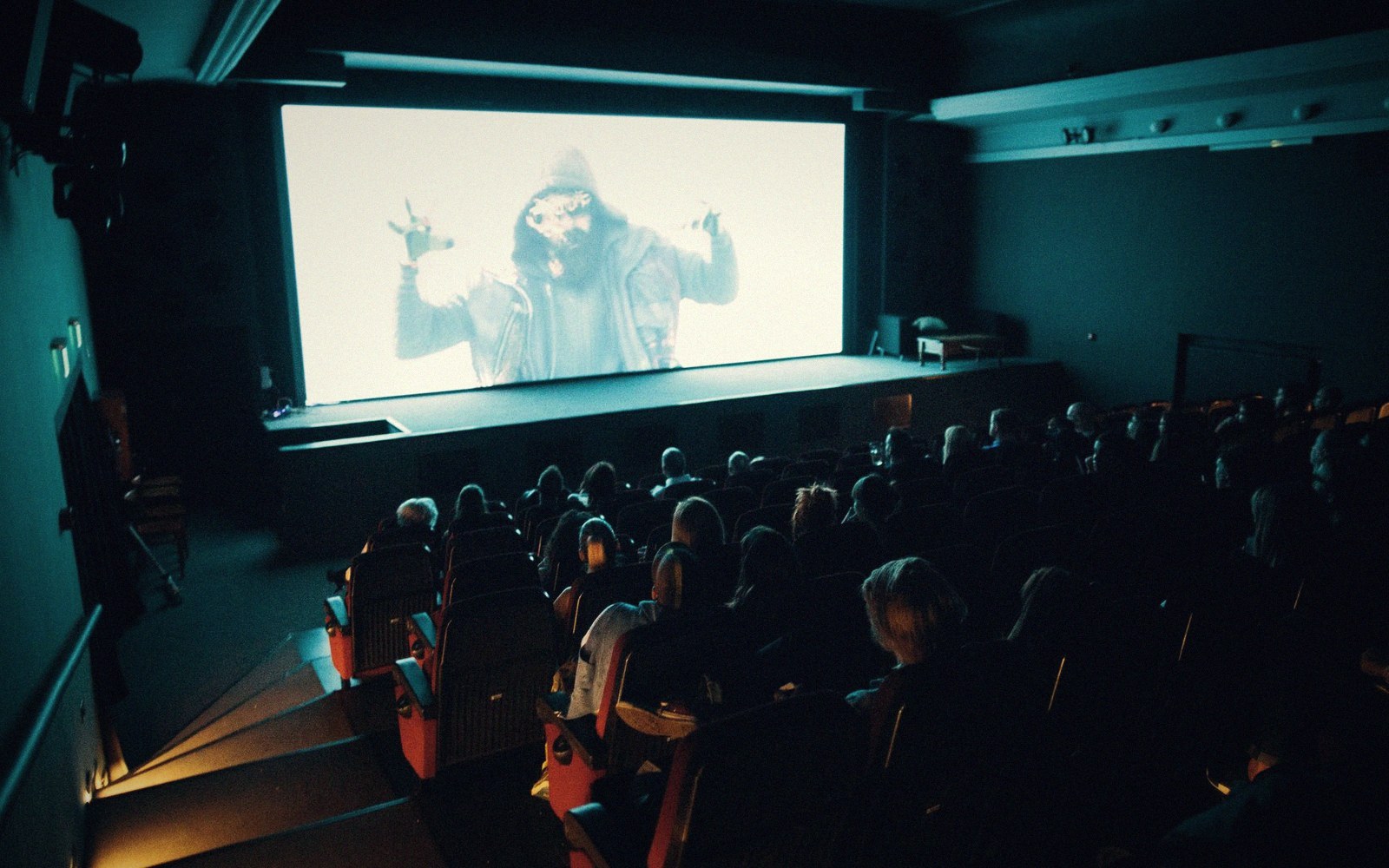
The seat you choose is also a choice about what kind of attention you're paying.
Why experienced festivalgoers keep moving toward the rear
Walk into a busy auditorium at a major festival — any one of the tented venues at Cannes, the vast open-air screen of Locarno's Piazza Grande, the cramped but beloved screens of the Cork Film Festival — and watch where the people who look like they do this every year actually sit. Not the critics with reserved-seating lanyards, not the accredited guests being ushered forward: the people who chose their own seat. They tend, with quiet regularity, to drift backward.
This is not laziness. It is calibration.
The back row — or close to it — gives you something the middle stalls cannot: the full frame of the experience at once. You see the screen as a screen, bounded by darkness, rather than as a surface that overwhelms your field of vision. Cinematography is composed for a notional seat in the house, roughly two-thirds back at standard throw distance, but the festival experience is not only about optimal image geometry. It is about knowing where you are while a film happens to you. The back row keeps you, slightly but usefully, in the room.
There is also the practical matter of the audience. From the rear, you have the whole crowd in peripheral view — and the audience you watch with is part of what you are attending to. You can feel a laugh before it arrives. You can see heads dip or stiffen. A silent auditorium has a texture you can read from the back that dissolves when you are embedded in the middle of it, surrounded on all sides by individual strangers rather than perceiving the crowd as a single body.
The geometry in brief
Throw distance — the distance from projector lens to screen — varies significantly between festival venues; mix calibration targets a mid-house position, not the rear
Dolby Atmos and high-density sound mixes are specifically engineered for a "sweet spot" in the room; the rear of a deep auditorium sits outside this
common at Cannes, Locarno, Toronto — have inconsistent acoustic envelopes, which changes the trade-off
What you gain, and what the position costs you
The sound case for the front-to-middle is real: most auditoria mix for the geometric centre of the room, and bass response — especially in digitally mastered films with dense, low-frequency sound design — falls off toward the rear. This is worth acknowledging plainly rather than pretending it away. If sound is the primary thing you are after, if you are watching something where the audio architecture is central to the work — certain late Apichatpong Weerasethakul films, anything heavy with Dolby Atmos design — the back row will give you slightly less of it.
But festivals are not cinemas in the stable, repeatable sense. Projection quality varies by venue. Mix calibration is inconsistent. The tent screens at outdoor sites, the community halls pressed into service as satellite venues, the converted proscenium stages: none of these are mixing for your specific seat, and often the sound is untameable wherever you sit. Under those conditions, the perceptual trade-off shifts. What the back row costs you in optimised audio, it returns in composure.
Composure is undersold as a festival skill. After three or four consecutive screenings, your perceptual reserves are depleted in ways that accumulate rather than reset. The fatigue is real and physical, and where you sit modulates it. Deep in a middle stall, the screen fills your vision completely; there is no visual rest, no horizon, no frame. From the back, there is darkness around the image, and that darkness is rest. It is the difference between watching a film and being consumed by one — and at a festival, where you will watch another one in ninety minutes, that difference is not trivial.
There is one further argument, slightly harder to articulate but no less true for it. The back of an auditorium is where a cinema reveals its shape. Shot from the rear, any screening room is a beautiful object — rows of lit faces tapering toward a single bright rectangle, the architecture of collective attention made visible. You cannot see this from the middle. You are the architecture then, not the observer of it. Sitting back, you hold both positions: inside the experience and quietly aware of its form.
This is, admittedly, a slightly strange thing to want from watching a film. But festival-going is slightly strange — a sustained, intensive encounter with cinema as a social event, not just as a sequence of individual films. The back row is the position from which both halves of that experience remain in focus simultaneously: the image, and the room in which the image is happening.
Choose it deliberately. Not every screening, not as a rule, but often enough that it becomes a tool rather than an accident of seating. The habitual front-stall seat puts you inside cinema; the back row lets you hold cinema at the distance where it becomes, very briefly, something you can see whole.
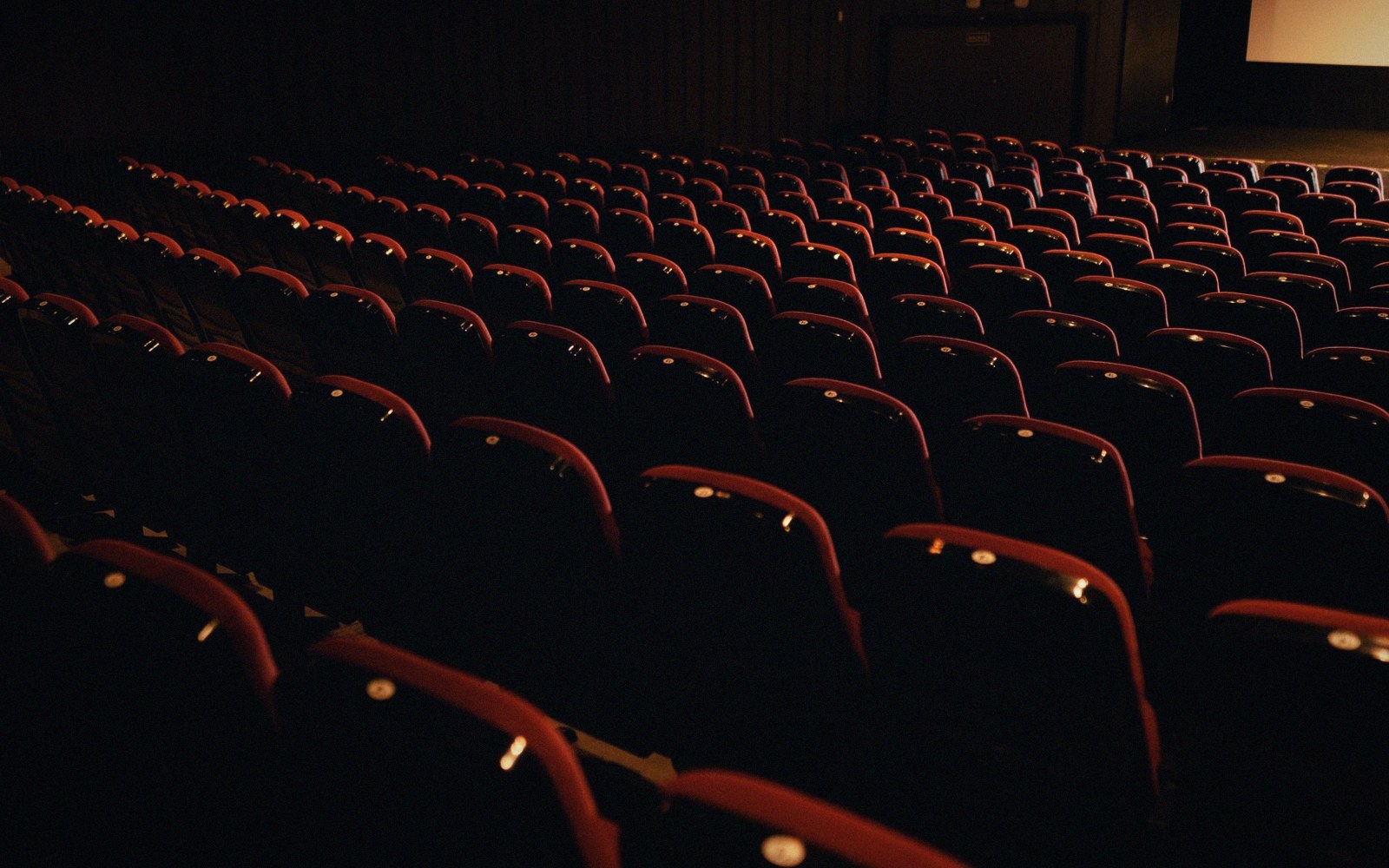
What the position actually changes
screen appears bounded by darkness rather than filling entire visual field
full peripheral view of the audience as a body, not just as neighbours
relevant after multiple screenings in a single day
the viewer remains conscious of being in a room, not only in the film